
Join us for a series of fascinating conversations about some of the most interesting books about cities and urban life. In keeping with the 2023 Festival of Urbanism theme of ‘Contested Urbanism,’ Dallas Rogers and Adam David Morton in Sydney, Jamie Peck in Vancouver, and Joe Penny in London interview authors about some of the most contested issues of our time:
— Dealing with climate change,
— Reckoning with First Nations dispossession,
— Thinking critically about animal justice,
— Literary histories of class war, and
— Getting radical about urban planning.
This book club is a part of the 2023 Festival of Urbanism.
Against the Commons: A Radical History of Urban Planning
Joe Penny, Lecturer in Global Urbanism at the UCL Urban Laboratory in London, talks with Álvaro Sevilla-Buitrago about his alternative history of capitalist urbanization through the lens of the commons.
Buy the book here: Against the Commons: A Radical History of Urban Planning
Against the Commons underscores how urbanization shapes the social fabric of places and territories, lending awareness to the impact of planning and design initiatives on working-class communities and popular strata. Projecting history into the future, it outlines an alternative vision for a postcapitalist urban planning, one in which the structure of collective spaces is defined by the people who inhabit them.

Álvaro Sevilla Buitrago is Associate Professor of Planning History and Theory, Universidad Politécnica de Madrid (http://multipliciudades.org/). Blending critical spatial theory and urban history, his research traces the role of planning in the genealogy of capitalist territorial formations, understanding it as a device for the dispossession and reconfiguration of autonomous modes of social reproduction. In recent works he has also analyzed the historical and contemporary dialectics of urban commoning and enclosure, and the spatial dimensions of the Spanish 15M movement and the politics of public space under austerity regimes more generally. Additional, cooperative research projects include the study of key geographical concepts for understanding the current capitalist crisis with the Barcelona-based group Espais Crítics, the exploration of extreme territories of urbanization with the Urban Theory Lab at Harvard Graduate School of Design, and the history of Totalitarian urbanisms in Europe with the UEDXX group at Bauhaus-Universität Weimar.
Joe Penny’s research interests sit between urban economic geography and urban planning, with a focus on issues of urban social justice in his adopted home city, London, especially: lived experience and governance of austerity urbanism; the restructuring of local state action through financialisaton of public land, housing, and social infrastructure; urban politics and grassroots resistance to austerity, gentrification and displacement.
Animals and Capital
Dallas talks with A/Prof Dinesh Wadiwel about his new book on the industrial production of animals for food, and where cities fit into this process.
Buy the book here: Animals and Capital
This book provides the first systematic application of Marx’s value theory to animal labour within the context of capitalist food systems. Dinesh applies Marx’s value theory which builds on and adapts recent work in animal studies, posthumanities, critical race theory and feminist theory to provide new insights into human-animal relations under capitalism. He explores animals as labour, and the implications for the interaction of human and animal labour forces. The book presents animal-sourced food as a means of subsistence and social reproduction for human populations, and it elaborates on animal resistance and its role within capitalist production. Building on Karl Marx’s value theory, Dinesh argues that factory farms and industrial fisheries are not merely an example of unchecked human supremacism. Nor a result of the victory of market forces. But a combination of both. In Animals and Capital Dinesh untangles this contemporary handshake between hierarchical anthropocentrism and capitalism.

Dinesh is an Associate Professor in human rights and socio-legal studies, with a background in social and political theory. He is an expert in human animal studies, and disability rights. He has a background working within civil society organisations, including in anti-poverty and disability rights roles.
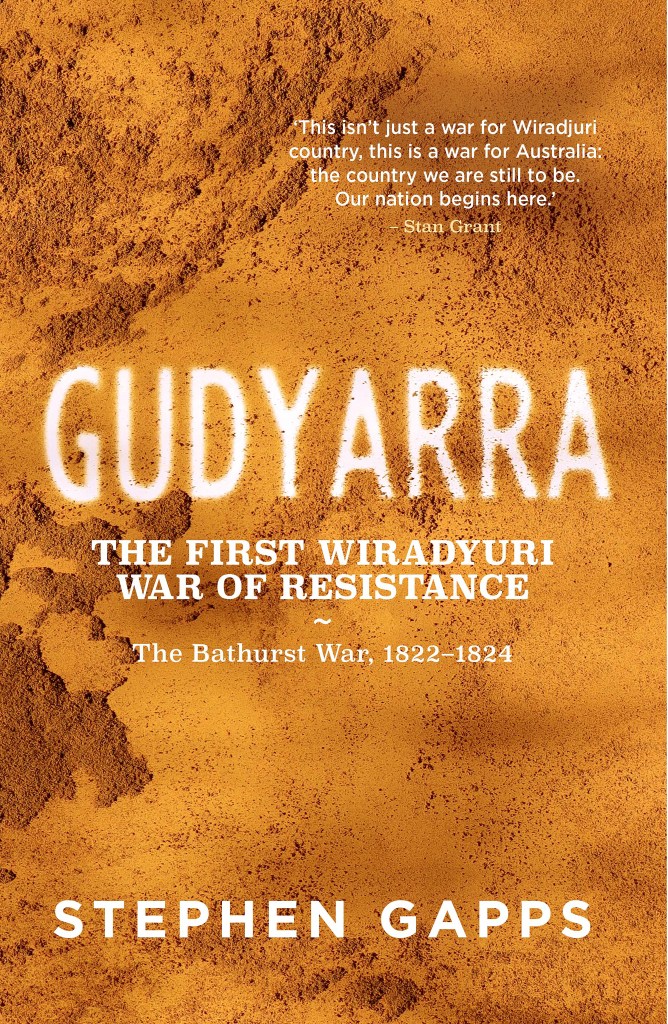
Gudyarra: The First Wiradyuri War of Resistance — The Bathurst War, 1822–1824
Dallas Rogers talks with Stephen Gapps about his new book, Gudyarra: The First Wiradyuri War of Resistance — The Bathurst War, 1822–1824
Buy the book here: Gudyarra: The First Wiradyuri War of Resistance — The Bathurst War, 1822–1824
‘In May 1824, what can only be described as a period of all-out, total gudyarra (‘war’ in the Wiradyuri language) had begun west of the Blue Mountains. Relations between Wiradyuri people and the colonists in the country around Bathurst had completely broken down, and the number of raids and killings occurring across isolated stock stations in the district had intensified.’ In Gudyarra, Stephen Gapps – award-winning author of The Sydney Wars – unearths what led to this furious and bloody war, beginning with the occupation of Wiradyuri lands by Europeans following Governor Macquarie’s push to expand the colony west over the Blue Mountains to generate wealth from sheep and cattle. Gudyarra traces the co-ordinated resistance warfare by the Wiradyuri under the leadership of Windradyne, and others such as Blucher and Jingler, that occurred in a vast area across the central west of New South Wales. Detailing the drastic counterattacks by the colonists and the punitive expeditions led by armed parties of colonists and convicts that often ended in massacres of Wiradyuri women and children, Gapps provides an important new historical account of the fierce Wiradyuri resistance.
Stephen Gapps has a long-standing interest in public history and the history of early colonial Sydney. In 2011 he won the NSW Premiers History Prize for Regional and Community history with my book Cabrogal to Fairfield – A history of a multicultural community. Since then he has held a position as a curator at the Australian National Maritime Museum. In 2014 he developed the exhibition War at Sea – The Navy in WWI and in 2015 curated the highly successful Black Armada – Australian support for Indonesian independence 1945-1949. In 2018 he worked on concept development of the new permanent displays at the museum that explore deep time and Australian maritime history. In 2017 he was awarded the NSW State Library Merewether Fellowship for a project on Australian resistance warfare for publication in May 2018 called The Sydney Wars – Conflict in the early colony 1788-1817, which became a book project. His most recent book is Gudyarra: The First Wiradyuri War of Resistance — The Bathurst War, 1822–1824
Class War: A Literary History
Adam David Morton, Professor of Political Economy in the Discipline of Political Economy at the University of Sydney, talks with Mark Steven about his new book, Class War: A Literary History.
A thrilling and vivid work of history, Class War weaves together literature and politics to chart the making and unmaking of social class through revolutionary combat. In a narrative that spans the globe and more than two centuries of history, Mark Steven traces the history of class war from the Haitian Revolution to Black Lives Matter. Surveying the literature of revolution, from the poetry of Shelley and Byron to the novels of Émile Zola and Jack London, exploring the writings of Frantz Fanon, Che Guevara, and Assata Shakur, Class War reveals the interplay between military action and the politics of class, showing how solidarity flourishes in times of conflict. Written with verve and ranging across diverse historical settings, Class War traverses industrial battles, guerrilla insurgencies, and anticolonial resistance, as well as large-scale combat operations waged against capitalism’s regimes and its interstate system. In our age of economic crisis, ecological catastrophe, and planetary unrest, Steven tells the stories of those whose actions will help guide future militants toward a revolutionary horizon.
Buy the book here: Class War: A Literary History

Mark Steven is Senior Lecturer in Twentieth- and Twenty-first Century Literature at the University of Exeter, UK. He is the author of Red Modernism: American Poetry and the Spirit of Communism (2017) and Splatter Capital (2017).
Climate Finance: Taking a Position on Climate Futures
Jamie Peck talks with Gareth Bryant and Sophie Webber about their new book Climate Finance: Taking a Position on Climate Futures.
Buy the book: Climate Finance: Taking a Position on Climate Futures
Responding to climate change is commonly understood as a financial challenge: What are the expected costs of the impacts of climate change? How much money is needed to reduce emissions to a safe level and to help people live in a changing climate? Who should pay? While these questions reflect the big issues of climate politics – about historical responsibility, unequal exposure and the terms of possible futures – they do not tell us a lot about the relationships between and contestations over climate change and finance capitalism. This book develops an expansive definition of climate finance and a critical framework for analysing its political economy. Drawing from a wide-range of case studies, the authors highlight the diversity, scale and contradictions of climate finance entanglements – from funding renewable energy, putting a price on carbon, responsible investing and financialising resilience

Sophie is an ARC DECRA Research Fellow and Senior Lecturer in Geography in the School of Geosciences at the University of Sydney.
Gareth Bryant is an Australian Research Council DECRA Fellow at the University of Sydney. He works as a senior lecturer in the Department of Political Economy and as economist-in-residence with the Sydney Policy Lab.
 City Road Podcast
Leave a comment